1. What Reading Skills Does an Informal Reading Inventory (Iri) Assess?
What are Reading Skills in Communication?
Reading is a affair of making sense of written linguistic communication rather than decoding impress to sound. It is the process by which we make sense of a text.
It is a dialogue betwixt the reader and the text. Reading is a completely private activity and people read at very unlike levels and speed.
In learning, information technology is reading that leads to perfection because books are the storehouse of knowledge.
Francis Bacon says, "Reading maketh a total man."
According to Addison "Reading is to the listen, what exercise is to the body."
Goodman defines reading equally "a psycho-linguistic guessing game."
Eddie Williams says, "Reading is a process of obtaining meaning from written text."
Co-ordinate to Frank Smith, "Reading is the reduction of uncertainty."
The end product of reading is comprehension.
Reading Comprehension
By comprehension, information technology is meant, the caste to which the reading able to excerpt relevant information from a text.
During the process of reading, an encoder and a decoder go involved in the sending and reception of the message respectively.
The encoder is the writer who acts equally the sender of the message, and the decoder is the reader who acts as a recipient. Reading requires the reconstruction of the bulletin.
It demands thinking and planning on the part of the reader. The reader has to distinguish the core of the text from the supporting ideas and at the same time, he has to recognize the subconscious meanings.
The total act of reading is a "decision-making" process equally the reader attempts to observe meaning co-ordinate to his own sense.
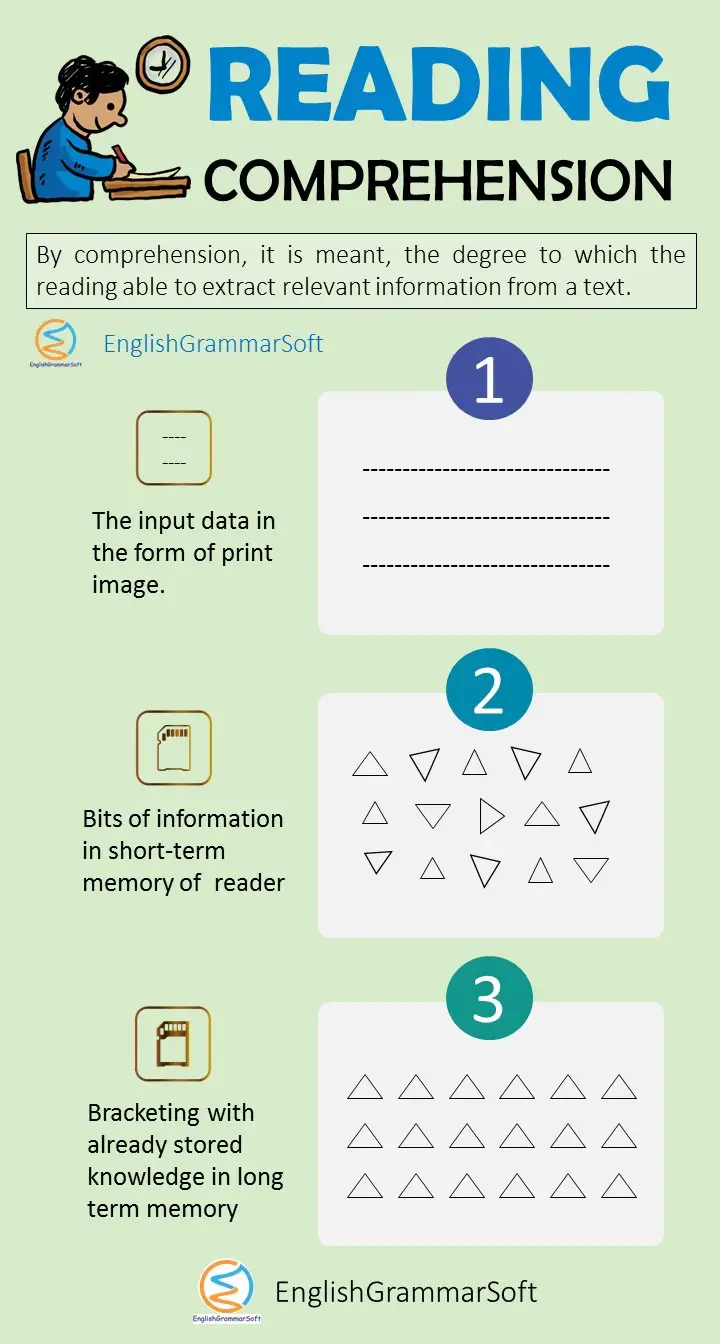
During the process of reading, the reader:
- Receives the epitome of words/symbols through eyes as visual information (if he is blind, he detects information technology through touch);
- The segments of information are held, for a short time, in the brusque-term memory;
- The data is transferred to long-term retentiveness where the fresh data is linked with already stored noesis. If there is any information gap in the input data the reader can span it with already stored noesis, making a sense of the message conveyed to him through written symbols.
Principles of Reading
While reading a reader has to go on in mind the following points:
- First of all, preview the title, contents and preface to get the general idea about the text.
- Read the passage at the normal speed.
- Endeavor to judge the meaning of the unfamiliar words through the context.
- Skip over unnecessary information.
- Browse the text to get specific information as quickly as possible.
- Skim the text to get the gist of the material.
- Distinguish between the writer's opinion and statement of facts.
- Infer the mood of the writer.
- Read silently
- Locate the topic judgement for a paragraph.
What are the four types of reading skills?
Following are the kinds of reading.
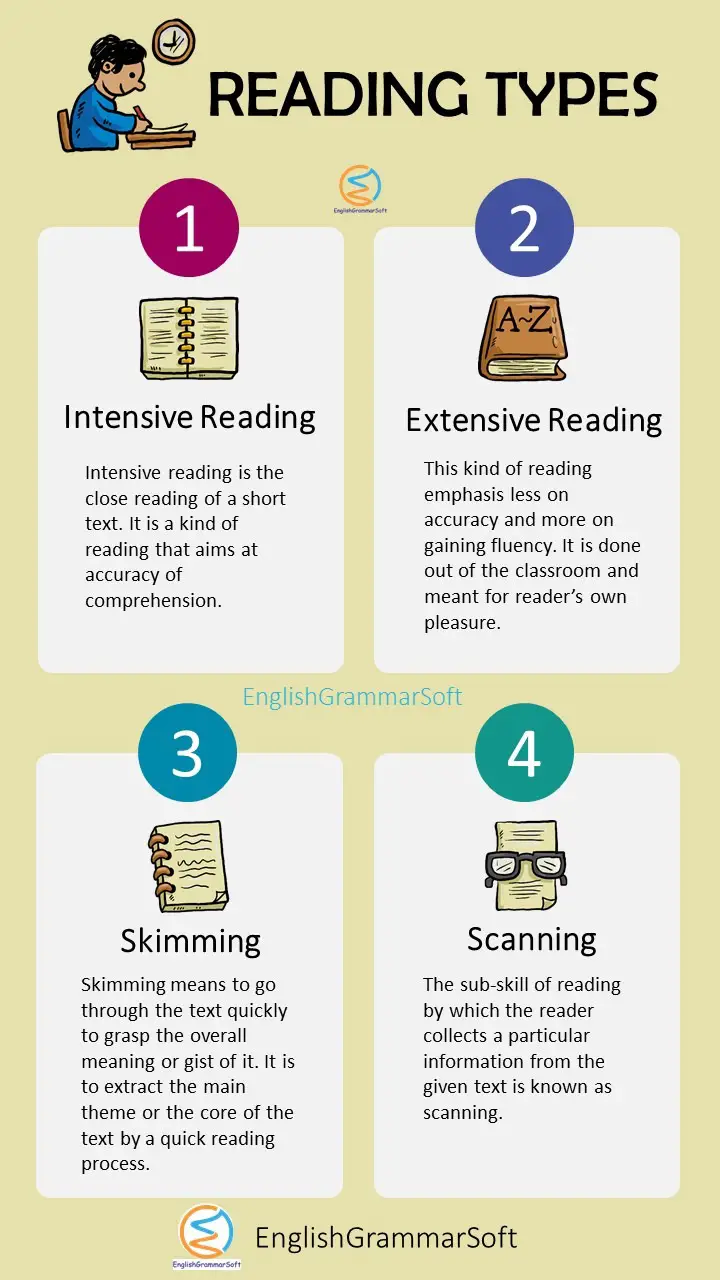
i – Intensive Reading
Intensive reading is the close reading of a short text. Information technology is a kind of reading that aims at accuracy of comprehension. It involves the reader in great attending to particular. Here, the reader has to learn the significant of each and every word. It is considered a useful tool of learning a foreign language."
ii – Extensive Reading
This kind of reading emphasis less on accuracy and more on gaining fluency. Information technology is done out of the classroom and meant for reader'south own pleasure. Solar day and Bamford suggest that the motto of all-encompassing reading "reading gain without pain."
iii – Skimming
Skimming means to go through the text quickly to grasp the overall meaning or gist of information technology. It is to extract the master theme or the core of the text by a quick reading procedure. The reader does not pronounce each and every word of the text, rather he focuses his attending on the subject thing, an overall view of the text, and prepares himself to respond such questions:
- Summarize the given text.
- Give chief points of the text.
- Rewrite the subject matter in your own words.
- Give a suitable championship to the given passage.
- Excerpt the central idea of the text.
Such questions indicate that skimming is like global listening.
How Skimming takes identify
- Be attentive to the clues and indicators like titles, headings, subheadings and typographical indicators (words in italics or bold letters) of important ideas.
- In an essay, read the commencement and the last paragraph to grasp the subject area affair with clarity of concept.
- Read the first sentence of each paragraph, as a thesis statement or a topic sentence that means the judgement containing the stand-signal or master idea.
- Expect at picture and diagrams with captions or words written below them.
- Annotation numbers, date and words that seem important.
iv – Scanning
The sub-skill of reading by which the reader collects a detail information from the given text is known as scanning. The technique of scanning involves the ability to reject or ignore irrelevant information. In society to locate a specific piece of information, the reader has to go through the text quickly and focus his attending on the relevant function of the text. For case:
- Look up a give-and-take in the lexicon for meanings.
- Search out a telephone number in the directory.
- Find out effect of a candidate from the Gazette.
- Locate weather conditions or functions in town in the paper.
- Extract the list of works from the biographical sketch of a writer.
Procedure for Scanning
- The required information has to kept in the mind of the reader.
- Decide which clues volition be helpful in finding out the specific information.
- A brisk eye movement on the pages of the text.
- Read the function of the text which contains the clues leading to the required information.
The clues which help the reader to find out a item piece of information may be a full sentence some words, a single discussion, a punctuation mark, alphabetical guild, or numbers etc.
The development of scanning skill needs grooming of eyes to move quickly, looking for the clues related to the required data. Scanning is useful to answer the questions such as:
- Fill in the blanks.
- Mark True or Imitation.
- Multiple Choice Items
- Curt answer/question
Reading Speed
Past adopting post-obit important points nearly reading we can develop a foundational work to enhance reading speed;
Reading is:
- An active too as a receptive skill.
- Decoding a message.
- Extracting information from a text.
- Getting specific questions answered.
- Making sense of the text an interactive process.
- Predicting and interpreting.
- Referring to and inferring data from a text
- A abiding procedure of guessing
- Constant making and remaking of hypothesis
The following principles of learning to read may also be considered as pre-requisite for developing appropriate speed in reading:
- The reader must develop the basic sense of what print looks like and how it works.
- The learner needs to develop the basic sense of what print looks similar and how information technology works.
- He has to develop the ability to recall near words every bit a sequence of phonemes or building blocks of spoken communication. He should understand that sentences are fabricated up of strings of separate words.
- Sensation of spelling patterns that recur beyond words hastens progress in reading.
- Although the ability to sound out words is important for learning to read, it is non enough. Written language is not just speech written downward. Instead text brings new vocabulary new linguistic communication patterns new thoughts etc. The reader must also larn to take the fourth dimension to reflect on these aspects of the text.
Strategies to Enhance Reading Speed
Reading in Chunks
In this technique our eyes take the view of group of messages and words. The reader should develop the ability to read in chunks to take in 4 or five words in a single eye glance.
Inferring the Meanings
There is no demand to terminate at difficult words just to look upwards their meaning in a lexicon. The difficulty can be faced by guessing the meanings of the words, keeping in view the context of their use. If the reader develops the skill to use clues, structure and context to guess the meaning, the involvement can be maintained alongwith improvement of reading speed.
Pre-viewing
The reader should brand himself conscious of the layout, headings, sub-headings, paragraph indentations and diverse type-faces or addicted of composing the text. Paying attending to the printed format can speed upward reading comprehension.
Anticipation
If the reader prepares himself to estimate what is likely to occur side by side in the text, he tin improve the speed of reading. This is some sort of anticipation while reading the text. He can use certain clues like the title and sub-titles etc, that may give him an thought about the chapter or contents of the book.
Silent Reading
Loud reading reduces the speed of reading as each give-and-take has to be pronounced according to stress and intonation patterns. Silent reading recommended to salve time by establishing a direct link between visual bear upon and comprehension. It will certainly enhance the speed of reading.
SQ3R
SQ3R is a systematic process of reading past which reading speed as well as comprehension (agreement) can be enhanced.
- Southward stands for survey
- Q stands for question
- First R stands for read
- Second R stands for remember
- Tertiary R stands for review
Faulty Reading Habits
Most of the students practice non enjoy reading books, rather they take them for exam purpose every bit a brunt. Moreover, when they start reading they face many issues due to their faulty reading habits. If they ready-bated their faulty reading habits they volition feel comfy with the textual fabric and enjoy reading.
Hither, we try to identify some faulty reading habits which are creating problems for the students.
- Finger Movement
- Head Movement
- Vocalization
- Lips Movement
- Reading without understanding
- Reading without awareness of objectives
- Word by word Reading
- Reading without guessing meaning
Strategies to Enhance Reading Skills
Adept readers have a wide range of effective approaches to texts and they can choose a strategy suitable to a given text. I of the goals of foreign language reading instruction is to provide students with as many strategies every bit possible.
- Utilise previous knowledge to predict what is presented in the following text.
- Skip some difficult parts of the text but become the outline of the text.
- Guess unknown words and phrases by using the clues or context.
- Realize what are important parts in a text and get out out automatically the unimportant ones.
- Exercise non dependent on text information through bottom-upwardly processing simply employ actively top-down processing. The imagination of the reader is very of import during reading, and his vicarious reading is an effective strategy.
- Change reading strategies according to the nature of text. At that place are different kinds of text and strategies of reading should differ according to the kinds of text.
- Accept the reading of text actively. Activating schemata is particularly useful for foreign linguistic communication learners. According to Schema theory, readers acquire data from text not passively but actively. Inference, generalization and personal-interest make expert readers.
- SQ3R formula (described earlier) is also a skillful strategy to enhance reading skills.
Activity to develop reading-based on accurate textile
Check your reading speed by using the post-obit formula:
lx x total No. of words = Words per infinitesimal
The time in seconds
Scale of Speed in Words per minute:
170-200 Wearisome
200-250 Average
250-300 In a higher place average
300-400 Fast
400-above Very fast
Further Reading
- Tips to improve reading skills
- Reading tips / Reading Skills
- eight Important Steps of Writing Procedure
- How to Write an Essay
- Speaking Skills in Communication
- Listening Skills (Definition, Types & Problems)
- Interview Skills (Training, Techniques, Questions & Answers)
Source: https://englishgrammarsoft.com/types-of-reading-skills-and-strategies/
0 Response to "1. What Reading Skills Does an Informal Reading Inventory (Iri) Assess?"
Post a Comment